Level monitoring in diesel tanks

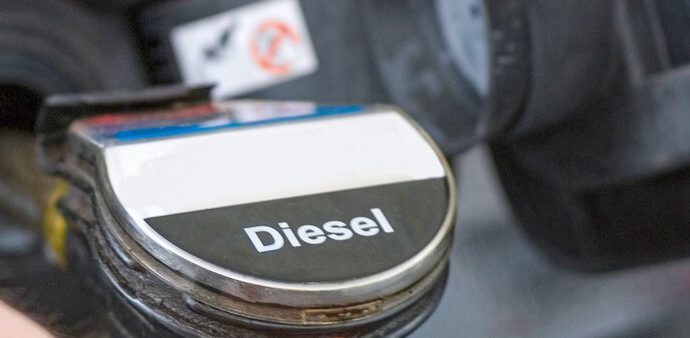
How is it possible for a mixture of water and diesel to come out of the fuel pump at the filling station? In recent years, water has repeatedly penetrated and contaminated underground diesel or gasoline tanks, especially during heavy rainfall. Engines do not take well to this at all. The engine may start for a brief time because the 2 fluids do not mix and a certain amount of diesel is left in the injection system. But the driver of this vehicle will not get far. That it because the water sinks to the bottom of the tank and is therefore sucked through the pump first. This can lead to significant damage. The entire fuel system must be cleaned and filters must be replaced.
To prevent this from happening, a diesel tank system manufacturer commissioned JUMO (Selfa is JUMO’s sole partner in West Africa) to find an overall solution. In a diesel tank, the level should be measured continuously so that messages for refilling can be sent and pump control can be implemented. At the same time, point level measurement should be used to detect possible water ingress.

Solution approach

The solution implemented by JUMO is based on a combination of products from the JUMO NESOS range. A float switch and level transmitter were integrated into one product so that installation is only possible via a tank opening. In addition, the product series has the necessary approvals for potentially explosive areas.

Innovative combined solution

The float switch is useful for the varying density of water and diesel fuel. It is designed to float on the interface between water and diesel, as a result of which an alarm message is possible. The JUMO NESOS combined sensor is designed specifically for application in diesel tanks with an overall length of over 4 meters. Level measurement enables service station operators to determine the actual level of diesel and the average consumption, which helps them to proactively and economically plan for demand.

Moreover, JUMO NESOS level measuring transformers provide a virtually continuous standard signal from
4 to 20 mA within a temperature range of -52 to +180 °C. The dissolution amounts to 5.5 mm. Variants with Pt100 or Pt1000 temperature sensors as well as with temperature switches, temperature transmitters, and displays are available as optional extras.

Automation system for plant control

Complete plant control can be implemented with the scalable JUMO mTRON T measuring, control, and automation system. The modular component concept combines variable I/O modules with powerful control panels. It is just as impressive in the area of measured value recording as it is for complex control tasks and sophisticated automation solutions. Extremely high-quality universal analog inputs for a wide range of input variables and the JUMO control algorithm that has been proven over the years to ensure a high degree of process reliability and the greatest possible transparency. A digital input module is used for the necessary online alerts. As a result, the user can receive information via email on their smartphone.

The JUMO diraVIEW digital indicator directly reports malfunctions on the tank. The basic device of this series is already equipped with 1 analog input, 2 binary inputs, 2 relay outputs, 2 logic outputs, and a voltage supply for two-wire transformers. 3 extension slots can be equipped with additional inputs and outputs as well as with interfaces. Alarm texts are particularly easy to notice due to the color change from green to red.

Project outcome

The level monitoring was implemented as specified. The combined solution of the float switch and level transmitter from the JUMO NESOS series ensures precise point and continuous level measurement. It signals when it is time to fill up and alarms if water should enter the tank. An online alarm is triggered through the JUMO mTRON T measurement, control, and automation system, which also controls the pumps. Also, color-coded alarm texts are displayed directly on the tank via the digital display of the JUMO diraVIEW indicator.

Which Is More Important: ISO 17025 Accreditation or ISO 9001 Certification?

To the casual observer, the terms “accreditation” and “certification” might sound as though they mean the same thing.
But ISO – the International Organization for Standardization and the world’s largest accreditation/certification group – defines them differently.

  • Accreditation – “A third-party attestation related to a conformity assessment body conveying formal demonstration of its competence to carry out specific conformity assessment tasks.”
  • Certification – “A third-party attestation related to products, processes, systems or persons.”

As Quality Magazine noted a few years ago, ISO’s hierarchy is set up so that accreditation outranks certification in terms of importance.

Accreditation applies only to bodies implementing a certification service. This could be an ISO 17025 accredited lab delivering an accredited calibration or testing certificate.

Another way to think about it: You received a degree from your university. It was a certification that you were proficient in your field of study. But your school needed to become accredited in order to show that it had the authority to deem its students proficient.

Two Different Groups Oversee The World’s Accreditation Bodies.

  1. The IAF, or International Accreditation Forum, which evaluate groups that accredit organizations that certify manage systems, products or people.
  2. The International Laboratory Accreditation Cooperation (ILAC), which assesses groups that accredit calibration and testing laboratories.

The confusion between certification and accreditation came about in part when some certification organizations began assessing labs to ISO 17025, a standard meant for deciding the qualifications of testing/calibration labs, and thus ILAC territory.

The ISO 9001 quality system is different than ISO 17025 in terms of purpose, emphasis and criteria. The standards line up in some areas, but they are separate, and achieving one does not mean you’ve met compliance with the other.

Do We Need ISO 9001 or ISO 17025?

IAF and ILAC have both said that ISO 17025 means accreditation rather than certification. Yet you may be reading this and wondering whether a company needs ISO 9001 certification, ISO 17025 accreditation, or both.

ISO 9001 certification applies to an entire organization. It’s an effective tool for management but does not include the necessary technical content to show that test/inspection/calibration data are reliable. Labs that perform calibration – and do not make products – need to meet ISO 17025 requirements, and not necessarily those of ISO 9001.

Suppliers who need reliable calibration backed by a quality system should seek out labs accredited to ISO 17025. And that accreditation should come from a body recognized under the ILAC’s mutual recognition agreement or MRA. These agreements are aimed at producing a network of accreditation bodies whose work is recognized around the globe.

For companies that do more than just laboratory services, it’s become common to get certified to ISO 9001 while having a lab accredited to ISO 17025.

At Selfa Calibration Laboratory, we chose to become accredited by NiNAS. Having this seal of approval from NiNAS means that we stand out even more in the already specialized market of calibration services provision.